
As we move into the fall season, we want to discuss a few projects we have scheduled, along with an update on the driving range and readdress trees since we have received feedback from members regarding the Mistletoe in the Pin Oaks.
As we communicated in an earlier post, due to the social distancing requirements and square footage restrictions, we made a conscience decision to practice off the synthetic surface this season to provide the membership with the maximum number of stalls. This actually allowed us to treat some Common Bermuda that encroached the new surface. This procedure was done with some new chemistry that we tried and seems to be highly successful in removing the undesirable grass. Since then we have reseeded the playing surface to grow in the areas that were weak and contaminated with the Common Bermuda. We plan to continue using the synthetic for the month of November and assess any opening at the end of the month. Some members have asked why we have to restrict the amount of stalls used on the grass surface. Based on our square footage and needed recovery time, we will only be using 12 stalls on the turf. With the social distancing guidelines in place that would only allow 6 stalls. The synthetic surface allows us to use 10 during this period, hence the decision to use the synthetic. Following is a post from November 2019 discussing the guidelines that will be in place with the new tee.
“As you already know, the rate of recovery on a driving range tee is appreciably slower than tees located on the course. When golfers practice within the confines of a stall, they remove divots from an area until the turf has been all but completely harvested. With so little vegetation left, recovery from underground portions of the remaining plant and/or seed takes much longer. By knowing the area of turf damaged on a daily basis, time of year, and the general rate of recovery, we will have essential guidelines for use to ensure a successful driving range tee program.
Those guidelines will include the following:
– Based on the square footage only 12 stalls will be used for all events and usage.
– Monday’s and non-member events will be synthetic turf use only.
– The rear of the stall will be outlined with rope and usage must stay within those boundaries.
– During the winter months, we may have to increase the use of the synthetic surface based on amount of use, due to cooler soil temperatures and much slower recovery time. Heavy rain events will also require us to use the synthetic surface.
It is very important that we strictly adhere to those guidelines based on our square footage, and climate that we have here in Sonoma.”
Along with the Common Bermuda removal and reseeding, we also replaced the sod that was struggling around the synthetic surface. Once we open the grass surface, we will aerate and seed the area behind the synthetic tee which receives a large amount of foot traffic.
Another area of the practice area I have received feedback on is the off color of the chipping area. What you see is the dying out of annual crabgrass that germinated in this area. As I discussed in a post this spring, the one area we did not get a timely pre-emergent down due to staffing levels was the clubhouse area. We will aerate this and overseed next Monday.
Some of you may remember a previous blog discussing the Mistletoe predominantly in the non-native Pin Oaks. The first of the Pin Oaks were planted on the property in 1988 and it has become obvious the 32 year experiment using these trees was not successful. In horticulture, it is essential to use plants that will be conducive to the environment they will be grown in. Following is a recap of the previous blog.
Mistletoe is a parasitic plant that tends to attack non-native species. After a thorough review of the trees that have Mistletoe on them, 95% are non-native Pin Oaks.
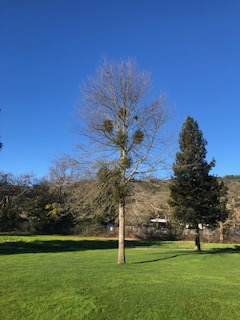
The native Live and Valley Oaks do not have any issues, so our long term plan will be to plant the native species when a need arrives. Any work done on the existing trees will be performed during the winter months when we have the available manpower. To eradicate Mistletoe, you have to physically remove it and then cover the area with material that will block the sunlight or else it will return. As you can imagine, this will be very time consuming, so the long term plan will be to replace them with the appropriate native species in strategic areas where trees are needed on the golf course. Hopefully this gives you some insight into Mistletoe and why it becomes a problem when using non-native plant material.
The first in-house project to begin this upcoming Wednesday, is the expansion and leveling of the Red tee at #1. Along with this, we will begin the process of removing the old railroad ties and regrade the area to the cart path edge. The railroad tie process will continue as we have available time to perform the work.
Aeration scheduled for the month of November is the following:
Monday November 2: Front nine tees.
Tuesday November 3: Back nine tees.
We will be closing the Driving Range Monday November 9th to perform aeration and seeding at the chipping area and landing area of the range, weather permitting.
Yours in turf,
Stacy l. Wallace, Golf Course Superintendent
 Sonoma Agronomy